
What is SCIP
The Studsvik Cladding Integrity Project SCIP (Studsvik Cladding Integrity Program), is an OECD/NEA supported international program operated by Studsvik, launched in 2004 and now prolonged to 2024, with participants from Europe, Japan, the US, China and Korea. The participants represent four categories; those who supply and manufacture the fuel, the power companies themselves, regulators and laboratories with similar assignments to Studsvik’s.
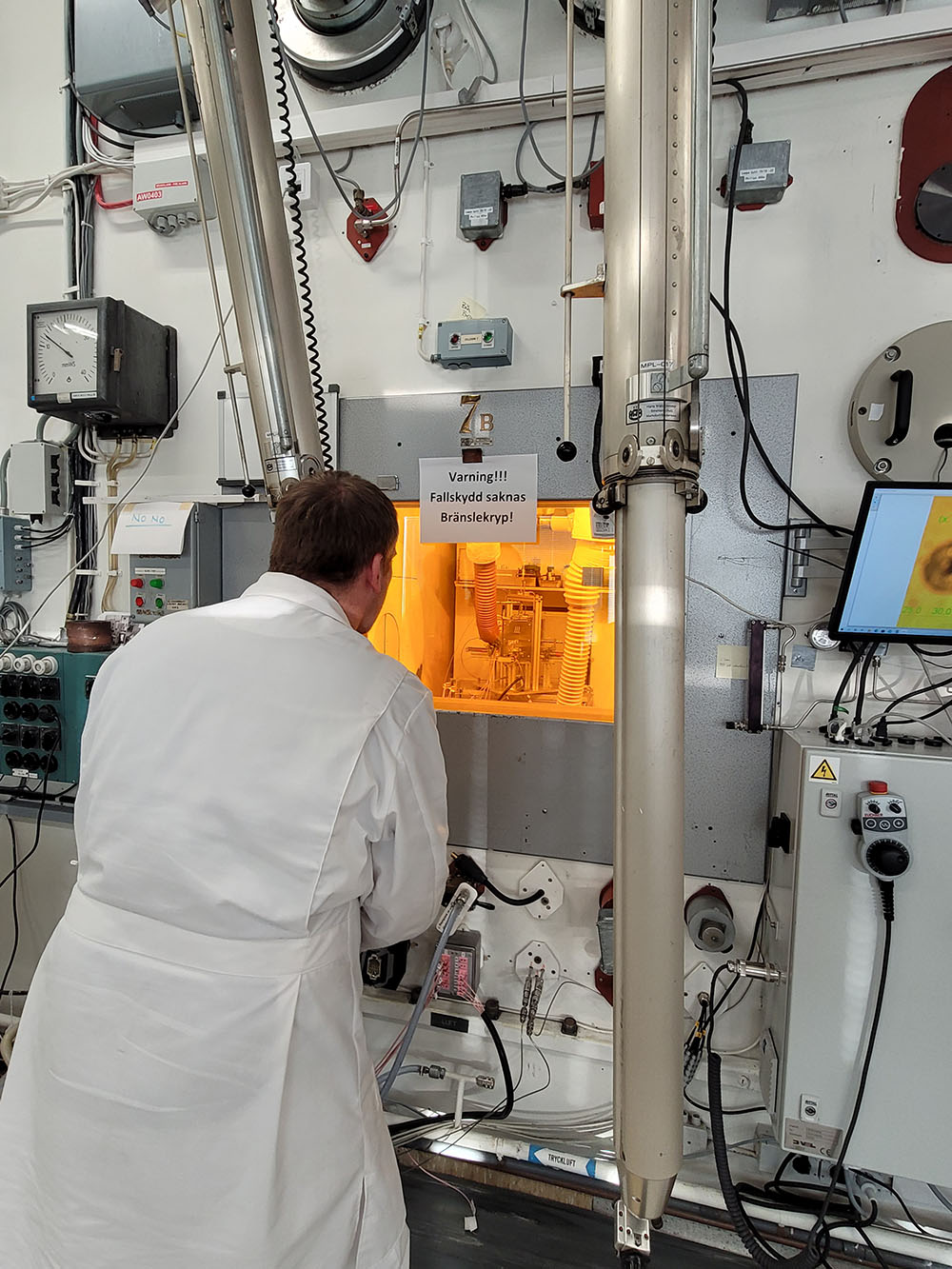
The Studsvik Cladding Integrity Project, SCIP, is an international OECD/NEA project that started in 2004. The project is being run in five-year phases with the participation of 40 organizations from 15 different countries.
In the first years detailed studies were made of how cladding properties affect fuel failures that may arise during operation. Fuel rod damage is costly for the industry, as it could lead for example to reduced reactor efficiency. It was clear from early on that studies of fuel damage were central. At the same time many fuel manufacturers were developing new advanced pellets, aiming to reduce the risk of this costly damage, which contributed to the great interest in these questions and a SCIP II (2009) on this theme could be successfully launched with an increased number of members.
In parallel with SCIP II Studsvik, on behalf of the American regulatory body U.S.NRC, carried out a LOCA test series and shared the results with SCIP members. The onclusions, which to some extent were not in line with expectations, brought the subject to the fore and when it was time for SCIP III (2014) the focus of the project moved to LOCA.
The fourth phase, SCIP IV, which has been in progress since 2019, aims to use basic simulations to improve understanding of fuel rod behavior in accident scenarios similar to LOCA and during storage after operation. Common to all phases of SCIP is the opportunity for experience feedback between the participating organizations, an important component for competence assurance within this complex area.
Within the project, Studsvik conducts advanced experiments on irradiated nuclear fuel in our laboratories. Most of the test rigs have been customized to meet the requirement specifications of project members. The experiments simulate for example nuclear fuel accidents and storage conditions which, together with advanced microscopy and other characterization technologies, provide the nuclear industry with important reference data for modelling of fuel behavior and decision support to regulatory bodies.
Participating Organizations
- Swedish Radiation Safety Authority (SSM)
- OKG Aktiebolag
- Vattenfall Nuclear Fuel AB (VNF)
- Studsvik Nuclear AB
- Nuclear Research Institute of the Czech Republic (ÚJV Řež)
- VTT Technical Research Centre of Finland, representing also Finnish industry parties
- Institut de Radioprotection et de Sûreté (IRSN)
- Electricité de France (EDF)
- EdF Energy
- Sellafield LtD
- Office for Nuclear Regulation (ORN)
- National Nuclear Laboratory (NNL)
- Commissariat à l’Énergie Atomique (CEA)
- Gesellschaft für Anlagen- und Reaktorsicherheit (GRS) mbH
- Framatome
- Swiss Federal Nuclear Safety Inspectorate ENSI
- Odessa National Polytechnic University (ONPU)
- Japanese Central Research Institute of Electric Power Industries (CRIEPI), also representing Japanese utilities
- Mitsubishi Nuclear Fuel Co Ltd (MNF), representing also Mitsubishi Heavy Industries, Ltd. (MHI) and Nuclear Development Corporation (NDC)
- Nuclear Fuel Industries (NFI)
- Nippon Nuclear Fuel Development (NFD)
- Nuclear Regulation Authority (NRA)
- Korea Hydro & Nuclear Power (KHNP)
- Korea Nuclear Fuel (KNF)
- Korea Atomic Research Institute (KAERI)
- The Korea Institute of Nuclear Safety (KINS)
- Consejo de Seguridad Nuclear representing Spanish industry and research organisations (CSN)
- United States Nuclear Regulatory Commission (NRC)
- Oak Ridge National Laboratory (ORNL)
- Electric Power Research Institute (EPRI)
- Global Nuclear Fuels (GNF)
- Nippon Nuclear Fuel Development CO., Ltd. (NFD)
- Westinghouse Electric Sweden (WSE)
- Centre for Energy Research, Hungarian Academy of Sciences (MTA-EK)
- Nuclear Safety Centre of China (NSC)
- China Nuclear Power Technology Research Institute (CNPRI)
- Shanghai Nuclear Engineering Research and Design Institute (SNERDI)
- Nuclear Power Institute of China (NPIC)
- TVEL Fuel Company (TVEL)
Info & IP
Information and Intellectual Property (extraction):
- The Signatories agree that all the results of this Project shall be the unrestricted joint property of all Signatories.
- Subject to prior approval by the Management Board and to restrictions applying to patents and copyrights, the Signatories shall have the right to publish information arising from the Project and information provided to the Project, except proprietary information.
- Each Signatory undertakes not to disclose any proprietary information received from another Signatory to any third party.
SCIP IV – Technical Description
SCIP IV is a safety related project launched in July 2019 running until June 2024. SCIP IV is divided into three different tasks including studies of fuel and cladding performance issues related to interim storage, LOCA events and PCI scenarios. As in previous SCIP phases, modelling efforts supporting planning and interpretation of experiments is an essential part of the project.